
AI-Powered / AI Interviews
AI interviews that ask the follow-up a form never could.
Applicantz AI Interviews runs a conversation, not a one-way recording. Define the role, your assessment criteria, the tone and how deeply the AI follows up. Candidates answer in chat, and in voice or video where you enable it. Your team reviews transcripts, summaries and criterion evaluations.
Nova, AI interviewer
Voice conversation, deep follow-ups
Tell me about a plan you had to change after it was already underway.

We launched the faster checkout, then watched people abandon it. I paused the rollout and went back to the support tickets.
Next question, written from that answer
What did the support tickets show that your testing had missed?
Research to decision
8/10Ownership
7/10Criterion evaluations, 1 to 10, for a person to review.
AI INTERVIEWS · PRICING
Get it with Applicantz, or sign up for AI Interviews on its own.
Use it inside Applicantz, where it is included with Paid, or sign up for AI Interviews on its own without the ATS.
AI Interviews · Two ways in
AI Interviews comes with Paid, or stands alone.
Already on Applicantz Paid? You have it. Want to try it on its own? Start on the standalone Free plan.
INCLUDED IN APPLICANTZ PAID
AI Interviews is part of Paid at $49/month. No additional standalone subscription is needed.
Get startedStandalone Free includes 5 interview sessions a month and one template. Standalone Pro is $39/month or $390/year with unlimited sessions and templates. Applicantz Paid is $49/month.
HOW IT WORKS
Configure the conversation once, then review evidence by criterion.
Define the role and the rubric
Add the title, description and objective, then the assessment criteria with a name and description each. Generation, refinement and templates can give you a draft to edit.
Choose how the conversation feels
Set the AI name, tone (casual, professional, formal or friendly), follow-up depth (light, moderate or deep), language and time limit. Enable chat, voice or video as the role needs.
Ownership
Review transcript, summary and scores
Read the messages, the summary and each criterion evaluation, and open any whiteboard submission. People decide who progresses.
THE OUTCOME
A first round that probes, then hands the decision to people.
A conversational interview can ask what a fixed form cannot: what changed, who disagreed, how a result was tested. The rubric stays consistent across candidates while follow-ups adapt, and people decide who moves forward.
One rubric for every candidate
Problem solving
Ownership
Communication

Priya Nair, own follow-up
You said the budget owner changed. Who took over, and what did you learn from them first?

Sana Ito, own follow-up
You handed it over late. What would have told you sooner that the plan was slipping?

Hana Sato, own follow-up
Walk me through how you tested the migration before cutover.
Questions adapt. The criteria stay put, so reviewers compare like with like.
THE INTERVIEW, END TO END
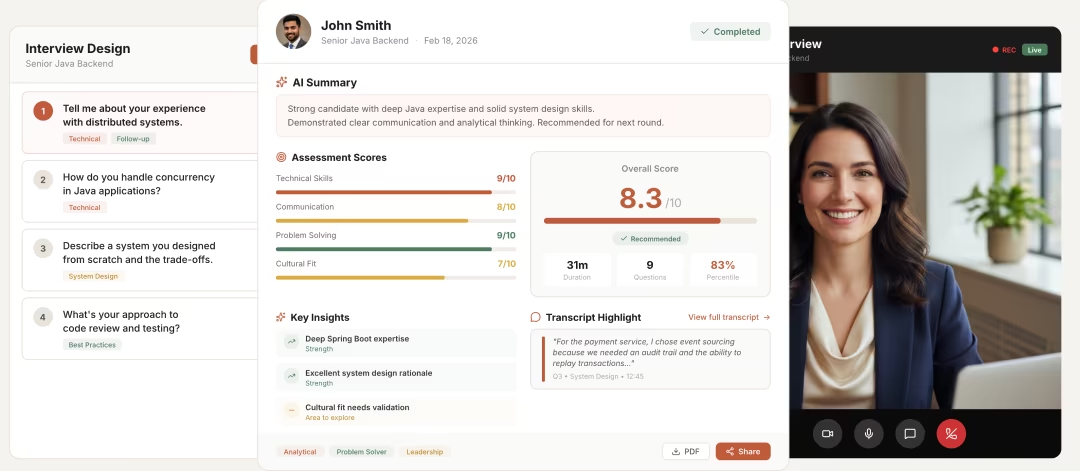
Design the interview. Review the evidence.
Set role-specific questions, give candidates a clear interview experience, then bring summaries, transcripts and criterion evaluations into human review. Your team decides what happens next.
THE DIFFERENCE
From one-way answers and phone-screen notes to a probing, reviewable first round.
Keep the human decision. Replace unstructured early screens with a consistent rubric, adaptive questions and a transcript your team can inspect. Explain the format to candidates and offer a route for those who need an alternative.
First-round screens meant ten calls a day.
Candidates complete a role-specific AI conversation without a recruiter attending.
Notes from phone screens varied widely.
Transcripts, summaries and criterion evaluations give reviewers evidence to inspect.
Scheduling delayed strong candidates.
Configured voice or chat sessions do not require a shared recruiter calendar slot.
Follow-up questions were improvised.
Adaptive follow-ups probe the answer; people review the evidence and plan the next conversation.
SEE IT WORKING
Every candidate meets the same rubric. Each gets their own follow-ups.
Configure the interview, invite candidates from a pipeline stage or a link, then read the transcript, summary and criterion evaluations. Coding and whiteboard questions add technical work to the same review.
Hana Sato
Backend Engineer, moved to AI interview stage
Invitation sent by stage action
Candidate completed a voice session and the results returned to the record.
Summary
Describes a careful migration: tested on a copy, compared counts, replayed traffic. Less detail on rollback.
Testing rigor
8/10Rollback planning
5/10Transcript excerpt
“I ran it on a copy first, compared row counts, then replayed a day of traffic before cutover.”

Helena reads the evidence and decides whether to book a live round.
BUILT INTO THE WORKFLOW
Everything an interview needs, set up around the role.
Your criteria, not a generic score
Each criterion has a name and a description, so evaluations refer to what you actually decided to look for in this role.
Adaptive follow-up depth
Light, moderate or deep probing changes how far the AI pursues an answer, while the rubric stays the same for everyone.
Chat, voice and video options
Voice sessions are live AI conversations that need no recruiter in the room. Availability depends on configuration.
Mixed question types
Combine open-ended, single-choice and multiple-choice questions with coding and whiteboard tasks, capturing both explanations and worked examples for your technical reviewers.
Tone, language and time limit
Match the interviewer persona to your employer brand and set a time limit, with language availability depending on setup.
Optional monitoring signals
Camera, microphone and screen settings can be enabled. They produce signals for a reviewer to consider, not proof or prevention of misconduct.
Transcripts and summaries
Review the full conversation alongside its summary and criterion evaluations, so your team can check answers in context before deciding on the next step.
CONVERSATION, NOT A RECORDING
A one-way recorded interview stores answers. A conversation can ask about them.
One-way video asks every candidate the same fixed questions and waits for you to watch the result. That is easy to send, but the interesting part of an answer is usually the thing a candidate half-says: a decision they reversed, a teammate who disagreed, a result nobody checked. A recorded prompt cannot ask about it.
Applicantz AI Interviews runs a live conversation. The AI works from your objective and criteria, and the follow-up depth you set (light, moderate or deep) decides how far it pursues a thin answer. Voice sessions are live AI conversations that need no recruiter in the room, so a candidate in another time zone can take the first round without a calendar slot.
None of this removes people. The output is a transcript, a summary and evaluations per criterion for your team to read, challenge and overrule.
One-way recording
Tell us about a time you changed a plan.
The interesting half-sentence goes unasked.
Conversation
Tell us about a time you changed a plan.
Follow-up
You paused the rollout. What did you check before deciding to?
CONFIGURABLE RUBRICS
Write the criteria. Let follow-ups adapt around them.
Each interview starts with a title, description and objective, then assessment criteria, each with a name and a description. Generation and refinement can draft the questions and criteria from the role, and templates give you a starting point. You edit them before any candidate sees the interview.
Example rubric: Senior Product Designer
- Stakeholder judgment
- Describes how they handled disagreement with product, engineering or leadership.
- Research to decision
- Shows how evidence from users changed a design choice.
- Ownership
- Names what they personally did, and what they would change.
Jon Avery
Senior Product Designer interview
Reviewer-annotated transcript
1We shipped the faster flow, then watched people abandon it. I went back to the session recordings and the support tickets before changing anything. 2I handed the spec over too late, and engineers had questions I should have invited sooner.
Research to decision
8/10Went back to user evidence before changing the design.
Collaboration timing
5/10Names a handoff that came late, and what would change.
Helena can read the passage, disagree with a score and decide.
Use the agreed criteria to discuss the evidence. Adaptive follow-ups can differ, so reviewers still need to inspect the answers rather than treating a score as proof of an identical or unbiased assessment. Pair the criteria with your team’s interview scorecards so the live rounds that follow use the same language.
TECHNICAL AND OPEN QUESTIONS
Mix question types, from open-ended to coding and whiteboard.
Questions can be open-ended, single choice or multiple choice, and technical roles can add coding and whiteboard tasks. The coding editor and whiteboard are part of the interview, so a candidate can write a function or sketch a system rather than describe one.
In the results, whiteboard submissions sit next to the transcript and criterion evaluations. That lets an engineering manager open the sketch, read the reasoning around it and decide whether a live technical conversation is worth the time. An AI evaluation of code or a diagram is a starting point for that reviewer, not a verdict on competence.
Coding question, candidate submission
1def dedupe(events):2 seen = set()3 out = []4 for e in events:5 if e["id"] in seen:6 continue7 seen.add(e["id"])8 out.append(e)9 return outWhiteboard

“I used a set so repeat checks stay cheap, and I append as I go to keep the original order.”
Technical reasoning
7/10CANDIDATE EXPERIENCE
Set the tone, language and time limit candidates will meet.
You name the AI interviewer and choose a casual, professional, formal or friendly tone, so the first contact sounds like your company. You set the language and a time limit, with language availability depending on configuration. Chat, voice and video can be enabled per interview.
Camera, microphone and screen settings can be turned on when your process calls for them. They give a reviewer signals to consider. They are not proof of misconduct and they do not prevent it, so use them proportionately, disclose them and let a person weigh them with everything else.
Tell candidates before they start what the format is, how long it takes and who reads the result. Offer a route to ask for help or an alternative, and treat noncompletion as a question, not an automatic rejection.
Name it, and pick the tone
The same opening in four voices
- Casual
Hey, I'm Nova. Walk me through your last project.
- Professional
Hello, I'm Nova. Please describe your most recent project.
- Formal
Good day. I am Nova. Kindly outline your most recent project.
- Friendly
Hi, I'm Nova, glad you're here. What have you been building lately?
Time limit and language
You set both per interview. Candidates see the limit before they begin.
Optional signals, never proof
Tell candidates what is on. A reviewer weighs the signals with everything else.
INSIDE YOUR PIPELINE
Use Applicantz—or keep your existing ATS.
Hiring with Applicantz? Run AI Interviews inside your recruiting workflow. Configure an interview invitation action on a pipeline stage, then send the invitation when a candidate moves into that stage. Completed sessions return their summary and scores to the linked record, beside the application in candidate profiles.
Already have an ATS? Add AI Interviews alongside your existing hiring system instead of replacing it. Supported Greenhouse and Lever integrations can send interview summaries and scores back as notes on the linked candidate or opportunity. Connect your ATS and map its candidate IDs to the Applicantz records before enabling the handoff. Support depends on the ATS and connection setup—not every system has the same integration.
Strong sessions lead to a live conversation. Move to interview scheduling for those candidates and carry the transcript into the debrief. Teams screening many applicants can read how this fits high-volume hiring, and distributed teams can see remote hiring.
Individual practice and coaching sessions live in the separate standalone AI Interviews product. They are a different offering from assessing candidates for a role.
Stage action configured: send AI interview invitation.

Linked Applicantz record
Rhea Castellanos, Product Designer
Summary and criterion evaluations arrive beside her application.
Your ATS ecosystem
Keep your hiring tools connected.






Result-note handoff: Greenhouse and Lever. Requires a supported connection and mapped candidate IDs. Other ATS workflows vary by provider and setup.
PLANS
Included in Paid, or start on its own.
AI Interviews does not require a separate subscription on Applicantz Paid. Usage depends on your plan and configuration, so check current terms before planning volume.
AI Interviews · Two ways in
AI Interviews comes with Paid, or stands alone.
Already on Applicantz Paid? You have it. Want to try it on its own? Start on the standalone Free plan.
INCLUDED IN APPLICANTZ PAID
AI Interviews is part of Paid at $49/month. No additional standalone subscription is needed.
Get startedIntegrations
Your interviews. Your choice of ATS.
Use AI Interviews within Applicantz or alongside your existing ATS. Supported Greenhouse and Lever connections return summaries and scores as notes on linked records, so your team can review results in its hiring workflow. External ATS handoffs require connection setup and candidate mapping.
























THE DETAILS
Good questions.
Straight answers.
Need something more specific? Our team is happy to walk through the details.
KEEP EXPLORING
Hiring Workflow
Interview Scorecards
Compare independent interview evidence against shared competencies and explicit rating anchors.
Hiring Workflow
Interview Scheduling
Coordinate interview availability and invitations without losing the candidate's context.
Hiring Workflow
Candidate Profiles
See the candidate's recruiting history, assessments and open questions in one shared record.
APPLY THIS TO YOUR TEAM
Remote hiring
Assess the work across locations without making candidates navigate unclear time zones or working expectations. Explain the actual overlap, use live and asynchronous assessment deliberately and keep decisions understandable to an distributed panel.
APPLY THIS TO YOUR TEAM
High-volume hiring
Keep suitable applicants visible when the queue grows faster than your team. Use assisted prioritization and asynchronous screening to organize attention, then preserve a human decision and a real next step for each candidate.
YOUR NEXT MOVE
Set up an AI interview for your next role.
AI Interviews is included in Paid at $49/month, with no additional standalone subscription. Draft the questions and criteria, test the experience yourself, then invite candidates and review their sessions before deciding who to meet.
 vs. Lever
 vs. iCIMS
 vs. BambooHR
 vs. Rippling
 vs. Workday Recruiting
 vs. Gem
 vs. JazzHR
 vs. Teamtailor
 vs. Bullhorn
