
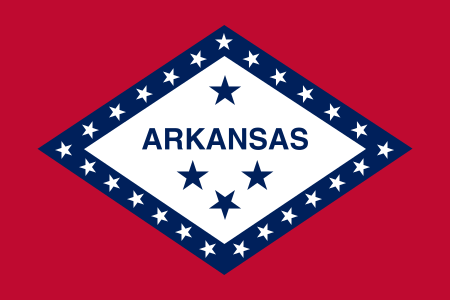
Overview
Arkansas employers must coordinate three different timing and coverage questions: whether the state minimum-wage law covers the employer, whether workers' compensation is required at the business's size and type, and when final wages are due after discharge. Arkansas has no general private-sector paid-sick-leave or paid-family-leave program. Federal FMLA and FLSA rules still apply independently, and their employer or employee coverage tests are not interchangeable with state headcount triggers. This guide is informational rather than legal advice.
What the category means. Arkansas adds a state minimum wage for covered employers and a low workers' compensation headcount threshold, while most overtime administration follows the federal workweek model. The final-pay deadline is tied to the next regular payday—not a simple seven-day-from-termination rule. This label is Applicantz’s editorial reading, not an official risk rating.
Key Arkansas laws
Arkansas Minimum Wage Act
$11 rate effective January 1, 2021; ongoingSets an $11 state minimum and covers employers with four or more employees. Where the employer is also covered by the FLSA, the higher applicable minimum controls; federal coverage can exist even when the Arkansas headcount test does not.
Applies to: Generally employers with 4+ employees, subject to the Act and federal coverage
Sourcesar-wageArkansas Department of Labor and Licensing — Minimum Wage and Overtime (opens in a new tab)ar-flsa-coverageU.S. Department of Labor — FLSA Coverage Fact Sheet (opens in a new tab)
Arkansas Workers' Compensation Act
OngoingMost employers with three or more employees must secure workers' compensation. Arkansas lists exceptions and cautions smaller employers not to assume an exemption without checking their work category.
Applies to: Most employers with 3+ employees; statutory exceptions apply
Sourcesar-wcArkansas Workers' Compensation Commission — Basic Facts for Employers (opens in a new tab)
Arkansas Act 853 — Discharge Wage Payment
2019Requires wages due after discharge to be paid by the next regular payday. Failure to pay within seven days after that payday may result in double wages. The deadline is payday-based, rather than seven days after separation.
Applies to: Employees discharged by an employer
Sourcesar-finalArkansas Legislature — Act 853 of 2019 (opens in a new tab)
Federal FLSA and FMLA
Federal laws; ongoingThe FLSA governs covered minimum wage, overtime, and records, subject to coverage tests and specific exemptions. FMLA gives eligible employees of covered employers unpaid, job-protected leave; neither federal law covers every worker on identical terms.
Applies to: Coverage and eligibility depend on employer, employee, worksite, and statutory exemptions
Sourcesar-flsa-coverageU.S. Department of Labor — FLSA Coverage Fact Sheet (opens in a new tab)ar-flsa-overtimeU.S. Department of Labor — FLSA Overtime Fact Sheet (opens in a new tab)ar-fmlaU.S. Department of Labor — FMLA Fact Sheet (opens in a new tab)
Pay rules
- Minimum wage
- $11.00/hour under the Arkansas Minimum Wage Act for covered employers; federal coverage and exemptions are separate, and the higher applicable floor controls.
- Overtime
- Generally 1.5 times the regular rate after 40 hours actually worked in a workweek for covered, nonexempt employees. FLSA exemptions depend on the applicable duties and compensation tests, not a job title alone.
- Final pay timing
- On discharge, wages due are payable by the next regular payday. Failure to pay within seven days after that payday may make double wages due; do not calculate seven days from the discharge date.
- Pay transparency
- The Arkansas labor sources reviewed set wage floors and wage-claim procedures, not a general private-sector job-ad range requirement. Employers can disclose a range voluntarily, but equal-pay and nondiscrimination rules apply independently. A written compensation policy should explain how range, experience, location, and performance decisions are applied.
Rates and thresholds change, and some cities and counties set their own. Confirm current figures with the sources below.
Sourcesar-wageArkansas Department of Labor and Licensing — Minimum Wage and Overtime (opens in a new tab)ar-finalArkansas Legislature — Act 853 of 2019 (opens in a new tab)ar-flsa-overtimeU.S. Department of Labor — FLSA Overtime Fact Sheet (opens in a new tab)
Leave rules
Federal FMLA
Unpaid- Duration
- Up to 12 workweeks in a 12-month period for most qualifying reasons
- Applies to
- Private employer generally 50+ employees in 20 workweeks; employee needs 12 months, 1,250 hours, and a 50-within-75-miles worksite; public agencies/schools have separate coverage
Job-protected leave and continued group health coverage are available only to eligible employees of covered employers. FMLA is unpaid unless employer-provided paid leave runs concurrently.
Sourcesar-fmlaU.S. Department of Labor — FMLA Fact Sheet (opens in a new tab)
Arkansas general private-sector paid sick/family leave
Unpaid- Duration
- No general statewide mandate identified
- Applies to
- No general state program; federal laws, contracts, and employer policies remain relevant
An employer may create paid leave by policy or agreement. Keep an adopted vacation payout promise distinct from statutory sick leave and from federal job-protected leave.
Sourcesar-wage-claimsArkansas Department of Labor and Licensing — Wage Claims (opens in a new tab)ar-fmlaU.S. Department of Labor — FMLA Fact Sheet (opens in a new tab)
Apply the $11 Arkansas floor only after checking coverage and exceptions
The Arkansas Department of Labor and Licensing lists a state minimum wage of $11 per hour, effective January 1, 2021. Its Minimum Wage Act covers employers with four or more employees; the agency directs employers covered by both Arkansas and federal law to pay the higher applicable standard. Federal enterprise or individual coverage can apply independently, so a business below the state headcount is not automatically outside the FLSA.
For most covered, nonexempt workers, overtime is one and one-half times the regular rate after 40 hours actually worked in a workweek. Paid holidays or sick days that were not worked generally are not hours worked for overtime computation. Arkansas and federal exemptions are occupation- and duty-specific; maintain a role analysis, time records, and a consistent definition of the workweek.
Sourcesar-wageArkansas Department of Labor and Licensing — Minimum Wage and Overtime (opens in a new tab)ar-flsa-coverageU.S. Department of Labor — FLSA Coverage Fact Sheet (opens in a new tab)ar-flsa-overtimeU.S. Department of Labor — FLSA Overtime Fact Sheet (opens in a new tab)
Check insurance at three employees, with statutory exceptions
Arkansas says most employers with three or more employees must carry workers' compensation insurance. The state expressly warns that exceptions exist and recommends that employers with fewer than three check before assuming they are outside the law. Agriculture, domestic work, and other categories may be treated differently; count the people and work actually covered rather than using a payroll-system label.
Workers' compensation addresses medical care and wage-loss benefits for qualifying workplace injuries; it is not ordinary sick leave or a substitute for FMLA. Train supervisors to report incidents promptly, give the employee claim instructions, and do not deduct the employer's insurance premium from wages. Keep the coverage certificate and current carrier contact details where managers can find them.
Sourcesar-wcArkansas Workers' Compensation Commission — Basic Facts for Employers (opens in a new tab)
Calendar final pay from the next regular payday
Arkansas Act 853 amended the discharge rule: an employee discharged by the employer must receive all wages due by the next regular payday. If the employer does not pay within seven days after that payday, double wages may be owed. This is not a requirement to pay within seven days after the termination date. Record the regular payday, separation date, and any disputed commission or bonus calculation.
The Labor Standards Section investigates wage claims of $2,000 or less, including final-pay, commission, vacation-pay, bonus, and deduction disputes. Vacation payout is not the same thing as sick leave: whether promised vacation is wages at separation depends on the employer's agreement or policy and applicable law. Pay undisputed earnings and preserve the policy version that applied when they accrued.
Sourcesar-finalArkansas Legislature — Act 853 of 2019 (opens in a new tab)ar-wage-claimsArkansas Department of Labor and Licensing — Wage Claims (opens in a new tab)
Do not mistake the state headcount rule for FMLA eligibility
Arkansas does not have a general statewide private-sector paid family-leave or paid-sick-leave benefit. FMLA may provide up to 12 workweeks of unpaid, job-protected leave, but a private employer generally needs 50 employees in 20 workweeks and the employee needs 12 months of service, 1,250 hours in the preceding 12 months, and a worksite with 50 employees within 75 miles. Public agencies and schools have separate employer coverage.
A three-person workers' compensation trigger, four-person state minimum-wage trigger, and 50-person FMLA threshold answer different questions. Do not use one threshold as a proxy for all employment obligations. The state sources reviewed do not require salary-range postings; federal equal-pay and anti-discrimination duties and any adopted employer policy still apply.
Sourcesar-wcArkansas Workers' Compensation Commission — Basic Facts for Employers (opens in a new tab)ar-wageArkansas Department of Labor and Licensing — Minimum Wage and Overtime (opens in a new tab)ar-fmlaU.S. Department of Labor — FMLA Fact Sheet (opens in a new tab)ar-flsa-coverageU.S. Department of Labor — FLSA Coverage Fact Sheet (opens in a new tab)
Facts and pitfalls
Worth knowing
- Arkansas's state minimum wage is above the federal $7.25 floor; use the current state rate and verify statutory exceptions.
- Federal FLSA coverage and exemption rules apply separately from the Arkansas wage framework.
- Arkansas final wages after discharge are due by the next regular payday, with a seven-day penalty period after that payday.
- Workers' compensation and state civil-rights laws use different employee thresholds and should be counted separately.
- FMLA is unpaid and requires both covered-employer status and individual service, hours, and worksite eligibility.
Easy to miss
- Do not confuse the end of the seven-day penalty period with a seven-day-after-separation final-pay deadline.
- Do not apply a single headcount to workers' compensation, civil rights, FMLA, and FLSA coverage.
- Do not assume state minimum-wage compliance alone satisfies overtime or recordkeeping rules.
- Keep voluntary leave balances distinct from job-protected FMLA time.
Employer checklist
A starting point for review, not a complete list of obligations.
- Check whether the Arkansas Minimum Wage Act's four-employee trigger applies and separately test federal FLSA enterprise or individual coverage.
- Pay covered workers at least $11 and maintain actual hours-worked records for each fixed workweek.
- Review each overtime exemption by duties and compensation, not by title or a salary label.
- Confirm workers' compensation coverage at three employees and investigate exceptions before concluding a smaller employer is exempt.
- At discharge, record the next regular payday and set a control to pay by that payday; use the seven-days-after-payday penalty window accurately.
- Keep written vacation, sick-leave, commission, and bonus terms and reconcile all earned amounts during separation.
Hypothetical example
Hypothetical: a covered Arkansas restaurant discharges a server on Wednesday, and the next regular payday is the following Friday. Final earned wages are due by that Friday; the statutory penalty window is measured from that payday, not from Wednesday. Payroll should also reconcile the server's regular-rate overtime and tips separately, because the final-pay date does not resolve whether the preceding workweeks were paid correctly.
An invented scenario for illustration. It is not a real company or a ruling.
Common questions about Arkansas
Is Arkansas's $11 minimum wage for every employer?
The Arkansas Minimum Wage Act covers employers with four or more employees, and covered federal employers are also covered by the state act. Federal FLSA enterprise or individual coverage may independently apply to a smaller employer or worker, so check both laws rather than assuming a headcount exemption.
When must a fired employee receive final wages in Arkansas?
Wages due must be paid by the next regular payday. If the employer misses that payday and does not pay within seven days after it, double wages may be owed. The seven-day period is not counted from the day of discharge.
Does Arkansas require workers' compensation for a small employer?
Most employers with three or more employees must carry coverage, but Arkansas identifies exceptions. Smaller employers should check the Commission's category-specific guidance instead of assuming they are exempt.
Sources and scope
Scope. Written by the Applicantz editorial team from the public sources below. It highlights common rules for small employers and does not cover every statute, exception, local ordinance or recent change. It is general information, not legal advice. Consider confirming specifics with the agency or an employment attorney. Last editorial update: October 1, 2026.
- ar-wageArkansas Department of Labor and Licensing — Minimum Wage and Overtime (opens in a new tab)
- ar-wcArkansas Workers' Compensation Commission — Basic Facts for Employers (opens in a new tab)
- ar-wage-claimsArkansas Department of Labor and Licensing — Wage Claims (opens in a new tab)
- ar-finalArkansas Legislature — Act 853 of 2019 (opens in a new tab)
- ar-flsa-coverageU.S. Department of Labor — FLSA Coverage Fact Sheet (opens in a new tab)
- ar-flsa-overtimeU.S. Department of Labor — FLSA Overtime Fact Sheet (opens in a new tab)
- ar-fmlaU.S. Department of Labor — FMLA Fact Sheet (opens in a new tab)
 vs. Greenhouse
 vs. Lever
 vs. Ashby
 vs. Workable
 vs. iCIMS
 vs. SmartRecruiters
 vs. BambooHR
 vs. Rippling
 vs. Workday Recruiting
 vs. Gem
 vs. JazzHR
 vs. Teamtailor
 vs. Bullhorn
